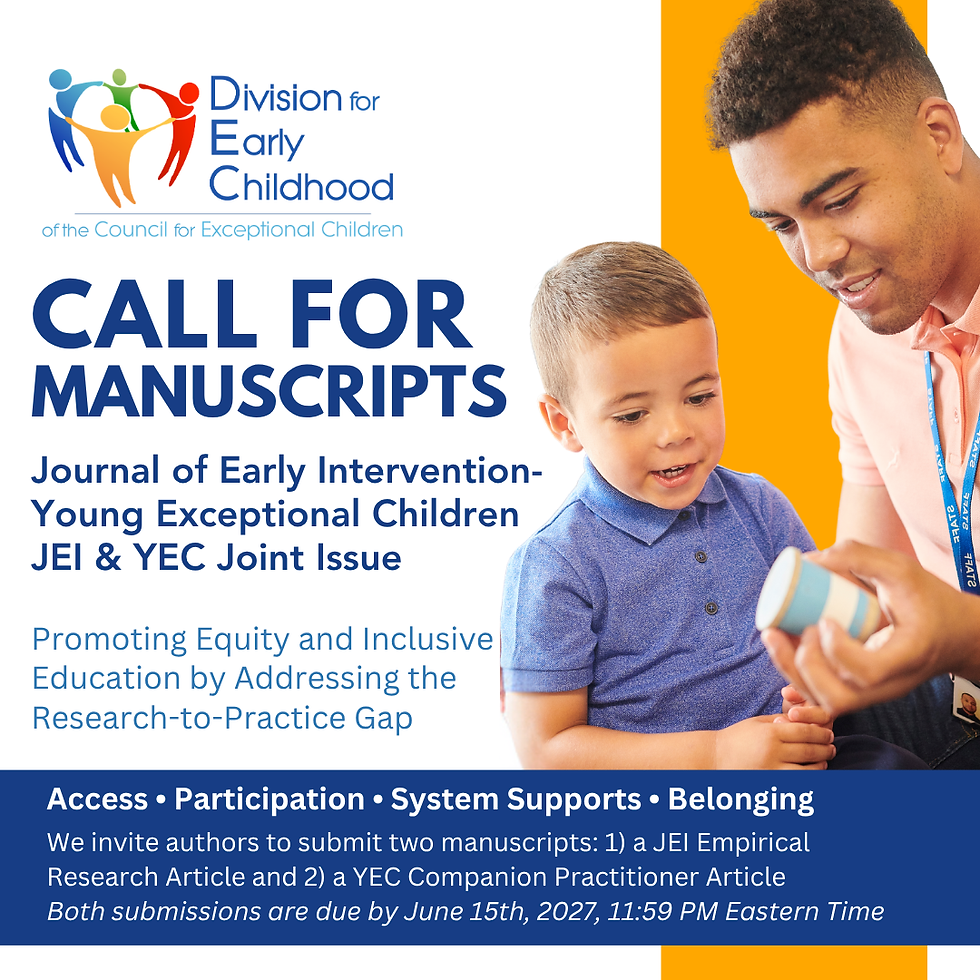
JEI -YEC Joint Issue Call for Manuscripts: Promoting Equity and Inclusive Education by Addressing the Research-to-Practice Gap
Journal of Early Intervention (JEI)-Young Exceptional Children (YEC) Joint Issue: Promoting Equity and Inclusive Education by Addressing the Research-to-Practice Gap
Promoting equity and inclusive practices and policies have been enduring values in early intervention and early childhood special education (EI/ECSE). While advancements have been made in these areas, the field has faced various challenges that have undermined these commitments. One such challenge has been translating research into actionable practice. This Journal of Early Intervention (JEI)-Young Exceptional Children (YEC) joint special issue aims to build on the Division for Early Childhood’s recent work to advance equity and inclusive education in EI/ECSE by addressing the research-to-practice gap that often persists. We aim to highlight scholarship that addresses persistent barriers to equity and inclusion for young children with disabilities and their families and explicates guidance for equitable and inclusive practice.
Advancing Equity and Inclusive Education in EI/ECSE
DEC has made multiple recent advancements to promote equity and inclusion for young children with disabilities and their families. In November 2023, DEC released the Racial Equity Point of View, which outlined the organization’s commitments to eliminate racial inequities in EI/ECSE and improve effective, responsive practice for all young children and families. The document highlighted the intersections between racism and ableism, which make it more likely for children with disabilities to experience injustice and magnify patterns of exclusion and inequity for children of color with disabilities. One of the strategies DEC named to promote racial equity and combat ableism was to support research that a) centers the experiences and wisdom of those made most marginalized by systemic oppression; b) enables responsiveness to children and families; c) adopts strengths-based frameworks; and d) is more widely accessible to practitioners and the general public. This special issue aims to highlight empirical research that aligns with these goals.
Most recently, DEC and NAEYC (2026) put forth a new conceptualization of inclusive education, stating: “Inclusion means intentionally providing equitable access to learning opportunities, implementing supports that promote participation and engagement, ensuring systems that affirm individuals with disabilities, and fostering belonging for each and every child (pg.3).” The updated position statement includes four defining characteristics of inclusion:
Access: Children and families are able to identify, enter, and sustain meaningful presence in a wide variety of high-quality early learning opportunities, activities, settings, and natural environments. Access is facilitated by the removal of physical and structural barriers and the promotion of social relationships that acknowledge, value, and welcome the autonomy and contributions of children and their families.
Participation: Young children and their families are able to meaningfully participate in a given space according to their preferences and capacity. Their participation is facilitated by individualized and differentiated supports that provide them with the knowledge, skills, and services essential for their desired outcomes.
System Supports: A comprehensive system of support ensures young children, their families, and early childhood professionals have access to high-quality early learning spaces in which they experience a sense of belonging. System supports ensure early childhood professionals access high-quality professional development opportunities and engage in continuous communication and collaboration to meet the needs and priorities of all young children and their families.
Belonging: Children and families experience a sense of belonging, or a feeling of “membership,” through relationships and interactions that honor their agency, affirm their identities, value them, and promote connection.
The special issue invites research and practice guidance that examines what it looks like to enact one or more of these components of inclusive education, ensuring that children and families receive supports that are effective and meaningful to them.
Joint Special Issue
Given the JEI-YEC combined nature of this special issue and the intention to close research-to-practice gap, we invite authors to submit two manuscripts: 1) an empirical research article describing a study with implications for equitable and inclusive EI/ECSE practice; and 2) a partner practitioner article describing how to use the findings of the empirical study. Following the DEC Racial Equity POV and DEC and NAEYC (2026) position statement, manuscripts may include:
JEI Empirical Research Article | YEC Companion Practitioner Article |
Implementation science: Studies using implementation science frameworks or methods to identify barriers and facilitators to inclusive education or specific dimensions of inclusion (e.g., access, participation, system supports, belonging). | Supporting implementation of inclusion: Practical strategies, tools, or processes practitioners and program leaders can use to address the barriers and leverage the facilitators identified in the empirical study. |
Participatory research: Studies collaborating with children, families, practitioners, or other community partners to understand their experiences, priorities, and perspectives regarding barriers to equity and inclusion and potential ways to address them. | Putting stakeholder priorities into practice: Guidance for incorporating the priorities, perspectives, and recommendations identified through the participatory research into everyday EI/ECSE practice, decision-making, or program improvement. |
Systems-level approaches: Studies examining state-, community-, agency-, or program-level approaches designed to increase access to and participation in inclusive settings for young children with disabilities. | Enacting systems change: Practical guidance for program leaders, administrators, practitioners, or cross-agency teams seeking to implement or adapt the systems-level approaches examined in the empirical study within their own contexts. |
Addressing exclusionary discipline: Studies examining experiences, disparities, interventions, or practices related to suspension, expulsion, or other forms of exclusion experienced by young children with disabilities, particularly children disproportionately affected by exclusionary discipline. | Preventing exclusion in practice: Actionable approaches practitioners and programs can use to promote participation, belonging, and individualized support for children while reducing reliance on exclusionary responses, grounded in findings from the empirical study. |
Affirming and equitable practices: Studies investigating practices that affirm the dignity, identities, assets, agency, and worth of children and families marginalized by intersecting systems of oppression (e.g., racism, ableism, linguicism). | Enacting affirming and equitable practice: Concrete examples, strategies, reflection tools, or decision-making guidance that help practitioners translate the practices and principles identified in the empirical study into interactions with children and families, instructional practices, family partnerships, or program procedures. |
*These examples are illustrative rather than exhaustive. Across all topics, the YEC companion article should be grounded in the findings of the JEI empirical study rather than simply addressing the same general topic. Authors should clearly demonstrate how the empirical findings inform the practices, strategies, tools, examples, or recommendations presented in the YEC article.
In line with both JEI and YEC’s aims and scope, the focus of manuscripts should be on children with disabilities and their families. We are particularly interested in work that addresses equitable and inclusive practices for children with significant support needs/low-incidence disabilities, multilingual learners with disabilities and their families, and children and families subject to multiple intersecting systems of oppression (e.g., racism, ableism).
We encourage submissions co-authored with (or solely authored by) practitioners, family members of children with disabilities, and scholars with disabilities. Both submissions (the manuscript describing an empirical study and the companion practitioner manuscript) must be submitted by June 15th, 2027. In your cover letter, describe how the manuscripts address the theme for the special issue and describe each author’s role and their contribution to the manuscripts and/or projects reported. Contact Angel Fettig (afettig@uw.edu) with questions.
Submission Guidelines
This special issue is a collaborative publication between the Journal of Early Intervention (JEI) and Young Exceptional Children (YEC). To support the goal of translating research into practice, authors are required to submit two companion manuscripts:
A JEI manuscript reporting an original empirical research study.
A YEC manuscript that translates the findings of the empirical study into practical guidance for practitioners.
The two manuscripts should address the same topic and be written as companion pieces. The YEC article should explicitly build upon the findings of the JEI article by providing actionable recommendations and implementation guidance for practitioners.
Manuscript Preparation
Prepare the JEI manuscript according to the current Journal of Early Intervention author guidelines.
Prepare the YEC manuscript according to the current Young Exceptional Children author guidelines.
Each manuscript should independently meet the formatting, organization, and submission requirements of its respective journal.
The manuscripts should be prepared as separate documents but submitted together as described below.
Submission Process
Combine the JEI manuscript and YEC companion manuscript into one Word document, with the JEI manuscript appearing first, followed by the YEC manuscript.
Submit the combined file through the Journal of Early Intervention online submission system.
In the cover letter, please:
Indicate that the submission is intended for the JEI–YEC Joint Special Issue.
Briefly describe how the two manuscripts complement one another and together address the research-to-practice gap.
Describe each author's roles in the field and contributions to the manuscripts and/or the project.
Review Process
The JEI and YEC manuscripts will be reviewed as a coordinated submission. Editorial decisions will consider both manuscripts together to ensure a strong connection between the empirical research and its translation to practice. Authors may be asked to revise one or both manuscripts to strengthen alignment between the companion articles in addition to feedback regarding the individual manuscripts’ alignment with JEI and YEC’s respective guidelines. Ultimately, the manuscripts will only be accepted for publication in the Special Issue as a pair.
Fit with the Special Issue
Prospective authors who are unsure whether their proposed manuscripts align with the scope and goals of this special issue are encouraged to contact Angel Fettig (afettig@uw.edu). Authors may also submit a brief abstract or summary of their proposed JEI empirical article and YEC companion article for informal feedback regarding fit with the special issue. This feedback is intended to help authors assess alignment with the special issue and does not constitute an invitation to submit or guaranteed acceptance.
Consideration for Regular Issues
Manuscript pairs that are determined to not be a strong fit for the joint special issue may still be considered for publication in JEI and/or YEC. When appropriate, manuscripts not selected for inclusion in the special issue will be considered through the respective journal’s standard editorial and peer-review processes for publication in a regular issue. Consideration for a regular issue does not guarantee acceptance, and each manuscript must meet the aims, scope, and publication standards of the journal in which it is considered.
JEI Co-Editors
Angel Fettig afettig@uw.edu
Hailey Love hailey.love@wisc.edu
YEC Co-Editors
Alissa Rausch alissa.rausch@du.edu
Christan Coogle ccoogle@gmu.edu