
EI/ECSE Standards (2020) Resources
Higher Education Faculty

Webpages
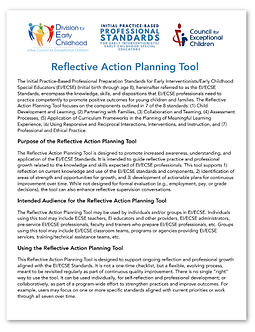
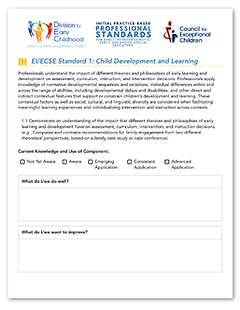
Reflective Action Planning Tool
The Reflective Action Planning Tool focuses on the components outlined in 7 of the 8 standards: (1) Child Development and Learning, (2) Partnering with Families, (3) Collaboration and Teaming, (4) Assessment Processes, (5) Application of Curriculum Frameworks in the Planning of Meaningful Learning Experience, (6) Using Responsive and Reciprocal Interactions, Interventions, and Instruction, and (7) Professional and Ethical Practice.
Purpose of the Reflective Action Planning Tool
This tool is designed to promote increased awareness, understanding, and application of the EI/ECSE Standards. It is intended to guide reflective practice and professional growth related to the knowledge and skills expected of EI/ECSE professionals. This tool supports 1) reflection on current knowledge and use of the EI/ECSE standards and components, 2) identification of areas of strength and opportunities for growth, and 3) development of actionable plans for continuous improvement over time. While not designed for formal evaluation (e.g., employment, pay, or grade decisions), the tool can also enhance reflective supervision conversations.


.png)
EI/ECSE Standards Key Ideas and Vignettes
This document provides a summary for each of the eight Initial Practice-Based Professional Standards for Early Interventionists/Early Childhood Special Educators (EI/ECSE Standards) and its components. Each summary also includes three short vignettes that illustrate how the Standards could be demonstrated in a birth to three early intervention context, a three to five preschool context, and a five to eight school age context. This resource is designed to be used in pre-service coursework or in-service professional development to help educators and other early childhood personnel examine the Standards through the lens of a child, family, and service providers.

Reflective Questions for DEC Vignettes and Standards
The Reflective Questions for DEC Vignettes and Standards provides a consolidated vignette and reflective questions for each age range (0-3, 3-5, and 5-8) covered by the EI/ECSE Professional Standards. This tool is designed to assist educators in connecting the standards to their own professional practice. Reflective questions are intended to be used for pre-service educator preparation as well as in-service professional development.

Additional Resources
-
EI/ECSE Glossary - The glossary contains terms and definitions used throughout the standards. The glossary can be used as a reference as you read the EI/ECSE standards and associated resources to aid understanding.

-
CEC/DEC EI/ECSE Standards, Components, and Supporting Explanations - This document provides a complete report of the EI/ECSE standards and their components. Additionally, supporting explanations are provided that describe why it is important for learners to gain the knowledge and skills represented by each component of the standard. These explanations can be used to support decisions about learning activities and practical experiences during pre-service preparation programs and in-service professional development activities.
-
EI/ECSE Standards, Knowledge Bases, and References - The standard knowledge base provides a concise summary of the relevant laws, other standards (i.e., InTASC, CEC, NAEYC, CAEP Elementary), DEC Recommended Practices, CEC HLPs, research and other literature and resources from the field that support each standard component. A full reference list is also included. These can be used to understand the support that exists and was used in the development of the standards and components. These may be used to help ensure coursework and professional development includes the most poignant resources and sources of information.
-
Themes Throughout the Standards - The following statements were developed to provide further explanation as to central themes which apply across all the new standards due to their fundamental influence on quality of EI/ECSE services. For pre-service, these statements may be topics addressed across curricula (e.g., as teacher educators do curricular planning, develop or revise courses). For PD they could be used to support development of materials and discussion topics (e.g., providing coaching around inclusive education).
-
DEC Position Statement on Personnel Preparation for Early Intervention/Early Childhood Special Education - Recognizing the centrality of quality personnel preparation, DEC has provided guidance for preparing professionals to enact the role of the early childhood special educator through the DEC position statements on personnel preparation for early intervention/early childhood special education (EI/ECSE).
-
Professional Practice-Based Standards Refereed Journal Articles - This documents includes APA reference citations and abstracts for 10 refereed journal articles specific to EI/ECSE Standards and one article about the K-12 Special Education Standards.
-
Crosswalk of the EI/ECSE Standards and the ECE Standards - This document reviews the alignment of the EI/ECSE Standards (2020) and the ECE Standards (2020). The crosswalk was completed to assist institutions of higher education (IHE) faculty to develop or revise blended preservice programs.
-
Crosswalk of the EI/ECSE Standards (2020) and the K-12 Special Educator Standards (2020) - The crosswalk was completed to assist institutions of higher education (IHE) faculty integrate the Standards into their preservice curriculum and also to assist professional development (PD) providers to integrate the Standards into PD content.
-
Crosswalk of the EI/ECSE Standards with DEC RPs - This document reviews the alignment of the EI/ECSE Standards (2020) and the DEC Recommended Practices (2014).
-
Crosswalk of the EI/ECSE Standards with DEC RPs and CEC HLPs - This document reviews the alignment of the EI/ECSE Standards (2020), the DEC Recommended Practices (2014), and the CEC High Leverage Practices (2017).
-
edTPA Early Childhood alignment of the EI/ECSE Standards (10/2022) - The Alignment of the 2020 DEC EI/ECSE Preparation Standards and Components with the edTPA Early Childhood rubrics (10/2022)
-
edTPA Special Education Alignment to EI/ECSE Standards (9/2022) - The Alignment of the 2020 DEC EI/ECSE Preparation Standards and Components with the edTPA Special Education rubrics (9/2022)
-
Cross-Disciplinary Competencies - The Cross Disciplinary Early Childhood Competencies align the standards across personnel serving young children and families to highlight commonalities in four areas: coordination and collaboration; family-centered practice; evidence-based practice; and professionalism and ethics. DEC is one of seven national professional organizations representing disciplines providing services in early childhood that have developed and endorse this alignment of personnel standards.
-
Performance Indicators - This document provides concrete examples of learning activities that learners can engage in to gain the knowledge and skills represented by the EI/ECSE standards. Performance indicators may be used to develop courses and curriculum, plan learning activities and assessments, and determine activities for learners to observe or engage in during field experiences and ongoing professional development activities.
-
Potential Sources of Evidence for Candidate Performance for Each of the EI/ECSE Standard Components - This table provides examples of sources of assessment evidence for the components of each of the seven EI/ECSE content standards.